Results on Life Cycle Assessment highlight how EVBAT’s solution addresses the main environmental hotspot of Electric Vehicles.
The EVBAT project is developing and validating at industrial scale a new generation of swappable battery systems for light electric vehicles, such as motorbikes, e-scooters, and micro-cars. At the core of this innovation is HYBA’s patented POD technology: a modular, weldless, and easily repairable battery architecture, designed to support a more circular and resource-efficient battery value chain.
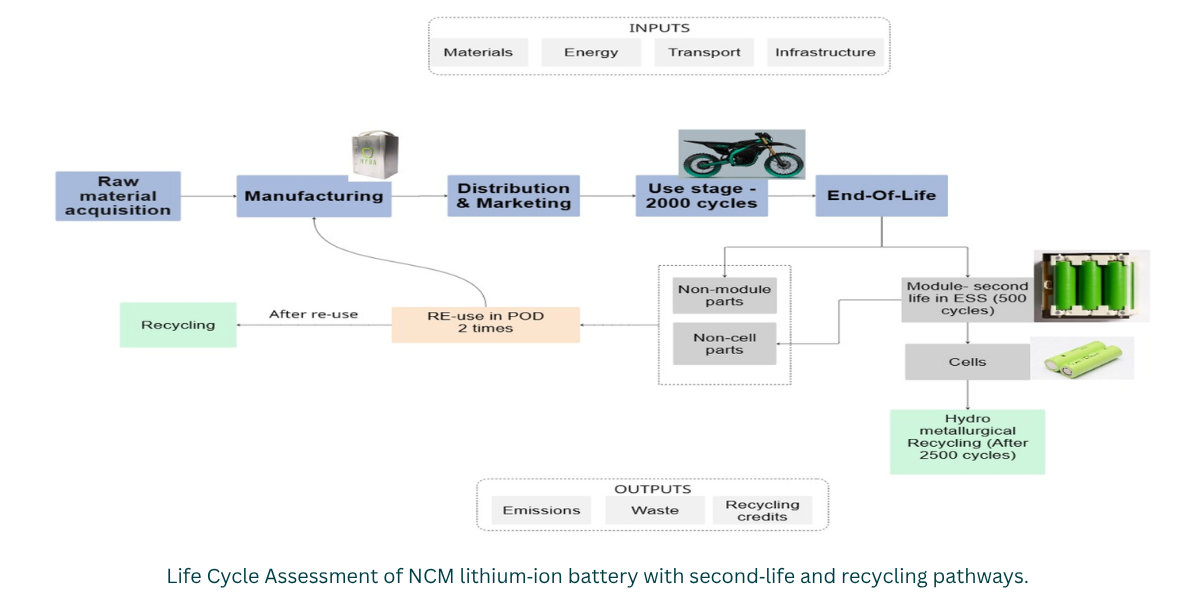
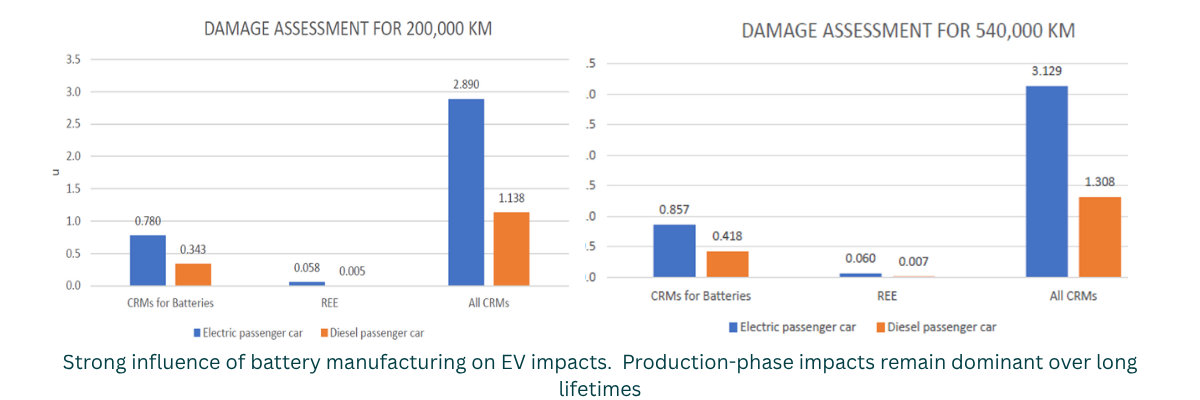
To evaluate the environmental performance and identify the main sustainability challenges for electric vehicles, the Institute of Energy Systems and Environment of the Riga Technical University (RTU) conducted a cradle‑to‑grave Life Cycle Assessment (LCA) for the full value chain of NCM lithium‑ion batteries, from raw material extraction to end‑of‑life recycling. The results confirm a clear message: battery production, particularly due to the extraction of raw materials, is the dominant environmental burden for lithium-ion batteries. These findings verify the design for circularity of the HYBA POD which eventually reduces the need of virgin materials as it facilitates repairing, extending batteries life, enables batteries reuse in second life applications, and makes recycling easier. The LCA also demonstrates that the use phase contributes only moderately to the overall environmental footprint, while distribution has a negligible impact. This means that the most effective sustainability improvements must target the early and late stages of the battery life cycle, which is precisely the points that the POD’s design addresses.
Life Cycle Assessment of NCM lithium-ion batteries
The study followed the ISO 14040/44 standards and assessed all stages of the battery life cycle, including raw material extraction, manufacturing, distribution, use and end‑of‑life recovery. RTU analysed the environmental burdens associated with each stage and identified the processes that contribute most significantly to the overall footprint. The analysis demonstrates that upstream processes, particularly raw material acquisition, account for the majority of environmental impacts across several categories, including climate change, resource use and human toxicity. The study also confirms that tail‑end emissions are significantly reduced during the use phase, yet the environmental burden shifts upstream due to the high demand for critical raw materials such as lithium, cobalt and nickel.
The LCA further shows that the use phase contributes only moderately to the overall environmental footprint, and the distribution phase has a negligible impact. This means that increasing the mileage of a battery does not proportionally increase its environmental burden, since the main impacts are embedded in the production stage rather than in operation. RTU’s findings therefore highlight that the most effective sustainability improvements must target the early stages of the battery life cycle.
A central focus of the study is the role of end‑of‑life recovery. RTU compared pyrometallurgical and hydrometallurgical recycling pathways and found that both processes provide substantial environmental benefits by reclaiming valuable materials such as cobalt, nickel and copper. These recovered materials generate environmental credits that offset part of the production‑related impacts by reducing the need for primary extraction and refining. Among the two pathways, hydrometallurgical recycling delivers stronger environmental benefits, due to its higher recovery rates and its ability to recover a broader range of materials. The study also includes a sensitivity analysis, which demonstrates that recovery efficiency is a critical factor in determining the overall environmental footprint. Lower recovery rates significantly increase the total impacts, while higher recovery rates improve the sustainability profile of the battery system. This finding underscores the importance of advanced recycling technologies and efficient end‑of‑life management.
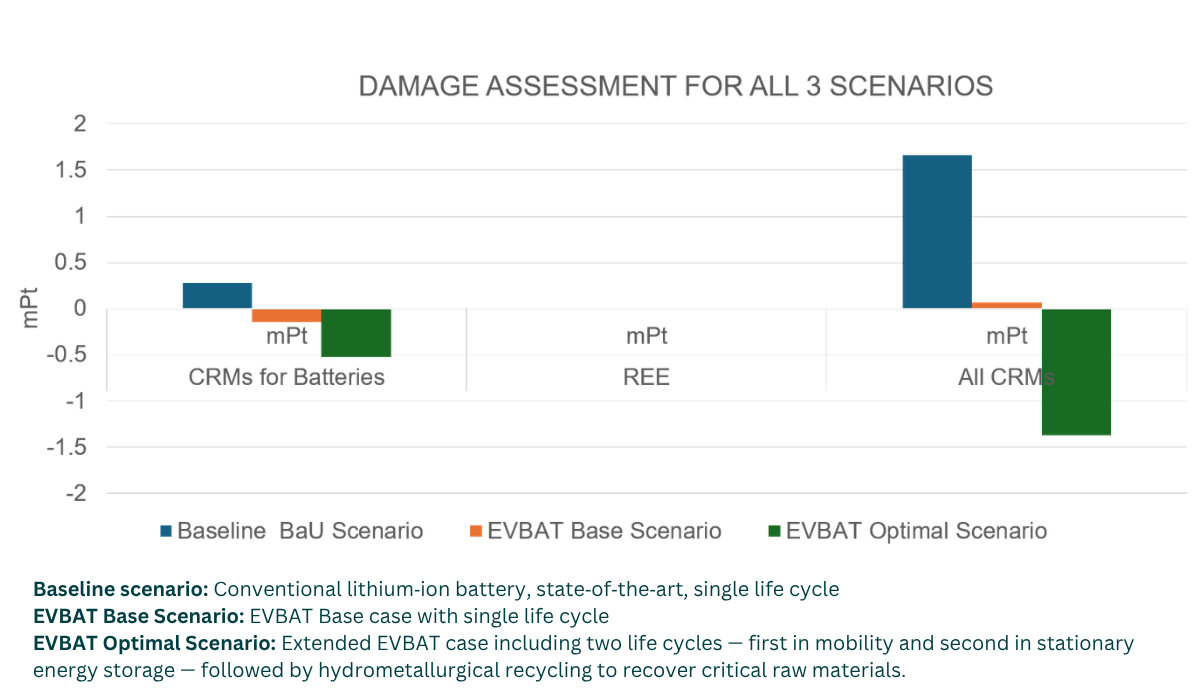
The research team also evaluated three life‑cycle scenarios including a benchmark case based on conventional lithium‑ion batteries and two EVBAT‑related scenarios reflecting the project’s intended use patterns.
Baseline Scenario: Conventional lithium‑ion battery, state‑of‑the‑art, single life cycle.
EVBAT Base Scenario: EVBAT use pattern with a single life cycle.
EVBAT Optimal Scenario: Extended EVBAT case including two life cycles—first in mobility and then in stationary energy storage—followed by hydrometallurgical recycling.
The EVBAT Base Scenario already demonstrates substantial improvements, as the impact from critical raw materials for batteries is negative, which means that the recycling credits associated with end‑of‑life recovery outweigh the upstream extraction burdens. However, when considering broader CRM categories such as rare earth elements and all CRMs combined, the EVBAT Base Scenario still shows a positive overall burden, indicating continued reliance on virgin materials. The EVBAT Optimal Scenario delivers the strongest environmental benefits across all categories, resulting in the lowest total impact, with negative values observed not only for battery‑specific CRMs but also for the broader CRM categories.
How EVBAT addresses the environmental challenges in the lithium-ion battery production
The RTU study confirms that any strategy capable of reducing material intensity, extending battery lifetime or improving end‑of‑life recovery has the potential to meaningfully reduce the overall footprint of electric mobility solutions. The POD system designed by HYBA follows a modular and weldless architecture that allows individual cells to be accessed and replaced without destroying the battery pack, which combined with the smart monitoring system, extends the battery’s life. By enabling non‑destructive disassembly, the design allows components to be reused in stationary storage, delaying the need for new production and reducing upstream impacts. Moreover, the POD system is engineered to facilitate high‑quality recovery by allowing clean separation of cells, casings and electronics, ensuring that future recycling processes can achieve the environmental benefits quantified in the LCA, supporting the transition toward closed‑loop material flows.
Sharing the findings with the research community
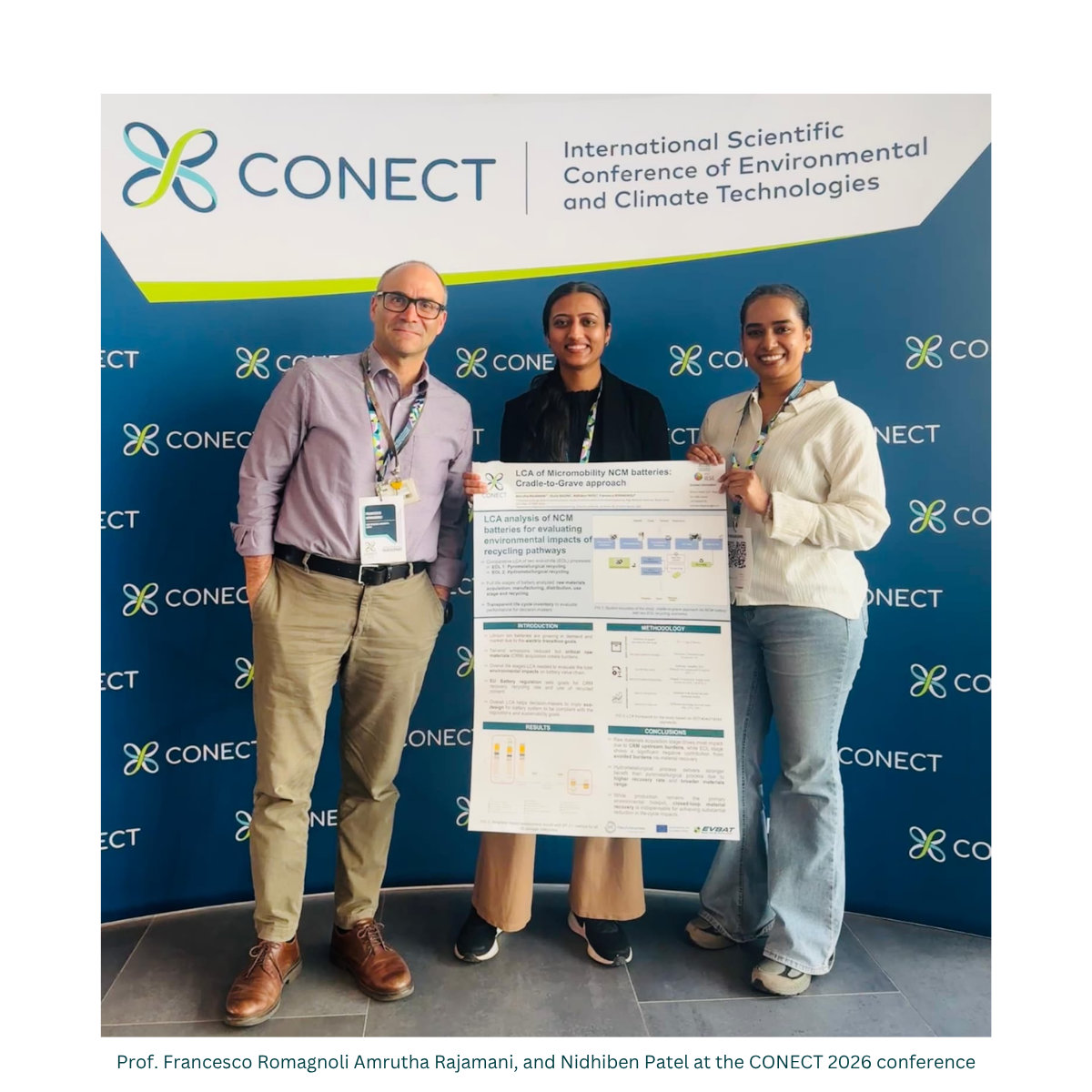
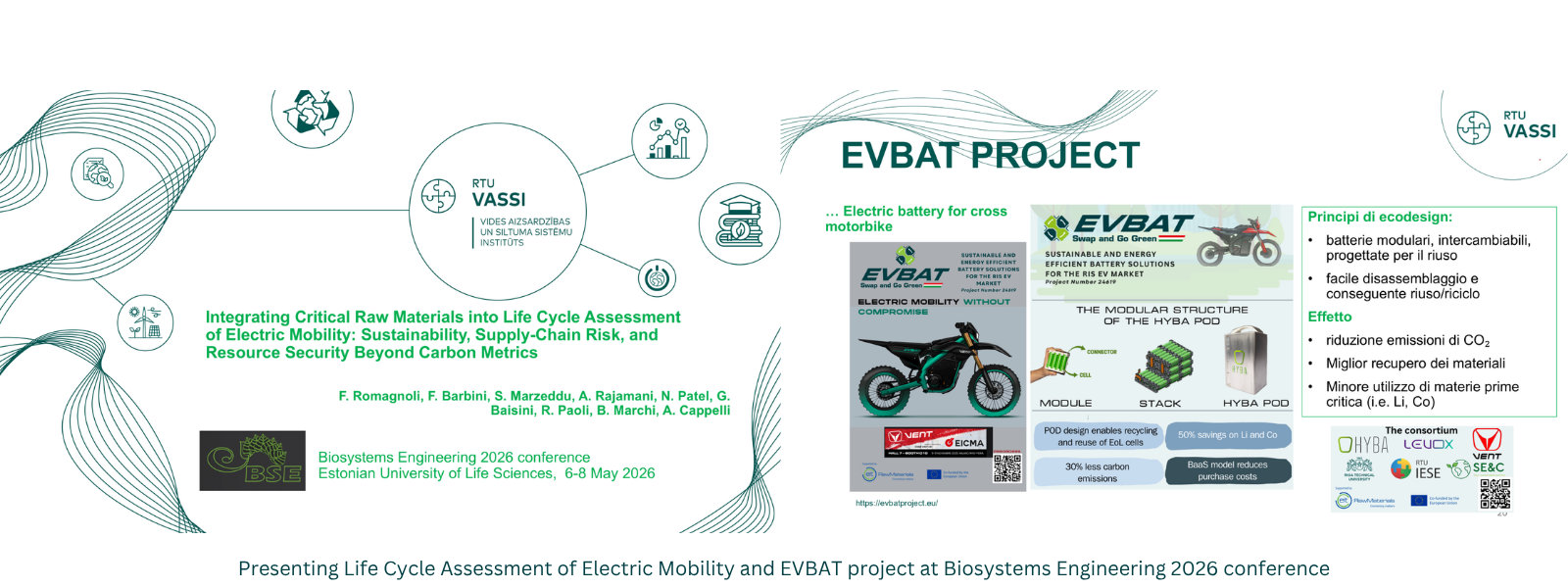
The Life Cycle Assessment carried out by the Institute of Energy Systems and Environment at Riga Technical University as part of the EVBAT project, has already resulted in a series of scientific contributions, such as submitted scientific papers and conference presentations. Professor Francesco Romagnoli first presented the study at the Biosystems Engineering 2026 conference, held at the Estonian University of Life Sciences from 6 to 8 May 2026. This oral presentation brought the findings, as well as the EVBAT project, to an international audience of researchers working in environmental engineering, sustainability assessment and circular economy applications. The work was also presented at the CONECT 2026 – Conference of Environmental and Climate Technologies, 12–15 May 2026, where the team, Prof. Francesco Romagnoli, Amrutha Rajamani, and Nidhiben Patel, contributed a peer‑reviewed abstract and a scientific poster detailing the cradle‑to‑grave assessment of NCM lithium‑ion batteries. The poster highlighted the environmental hotspots across the battery life cycle and compared pyrometallurgical and hydrometallurgical recycling pathways, offering valuable insights into the role of end‑of‑life recovery in reducing environmental burdens.
The research team is also presented the results at the SETAC Europe 2026 Annual Meeting, May 19th in the Netherlands. SETAC, the Society of Environmental Toxicology and Chemistry, is one of the leading global platforms dedicated to advancing environmental science and supporting science‑informed decision‑making. This event enabled the LCA findings to reach a broad community of experts in environmental impact assessment and life‑cycle modelling.